
Edwin Arkel Rios
PhD Candidate in EECSNational Yang Ming Chiao Tung University
Hsinchu, Taiwan
edwinarkel.rios@gmail.com
[GitHub] [Resume]
|
|
Edwin Arkel Rios
PhD Candidate in EECSNational Yang Ming Chiao Tung University Hsinchu, Taiwan edwinarkel.rios@gmail.com [GitHub] [Resume] |
My name's Edwin and I come from Panama. I received the B.S. degree in
Energy Engineering from National Cheng Kung University (NCKU), Tainan,
Taiwan, in 2019. I enrolled at National Yang Ming Chiao Tung University
(NYCU) to pursue an M.S. and then a Ph.D. degree in Electrical
Engineering and Computer Science (EECS), in 2019 and 2021,
respectively, where I have been co-supervised by Professor Bo-Cheng
Lai (賴伯承) and Professor Min-Chun Hu (胡敏君).
My research is focused on the design of efficient deep learning models.
In particular, I have done work on time-series for heart-rate
monitoring, model compression using knowledge distillation and
self-supervised learning, and efficient fine-grained image recognition
systems incorporating parameter-efficient transfer learning,
token pruning for vision transformers, and efficient discriminative
feature selection mechanisms. More recently I have worked on
low-bit quantization of speech and audio language models, and on
hardware-software co-design of FPGA accelerators for vision and
graph neural networks.
|
Parameter-Efficient Image-to-Video Adaptation for Action Spotting of Illegal Waste Dumping. WACV WasteVision Workshop 27 |
|
|
Evaluating the Impact of Language Resourcing on Post-Training Quantization for Multilingual ASR. NeurIPS AXIOM Workshop 26 [Paper] |
|
|
SECG: A Dataset and Benchmark for Seamless Egocentric Continuous Gesture Recognition. ACCV 26 [Paper] |
|
|
Towards Fine-Grained Image Recognition from Scratch with Teacher-Guided Data Augmentation. ACCV LFSD-CV Workshop 26 [Paper] |
|
|
Evaluating Hyperparameter Robustness of Backbone and Pretraining Strategies in Fine-Grained Image Recognition. ACCV CV4DC Workshop 26 |
|
|
Does Regional Decoder Specialization Help Low-Resource ASR Based on the SLAM-ASR Framework? ROCLING 26 |
|
|
Zero-Shot Spoken Language Understanding with SLAM-ASR: What Do Monolingual ASR-Trained Linear Projectors Enable? EMNLP IMPACT-Speech Workshop 26 [Paper] |
|
|
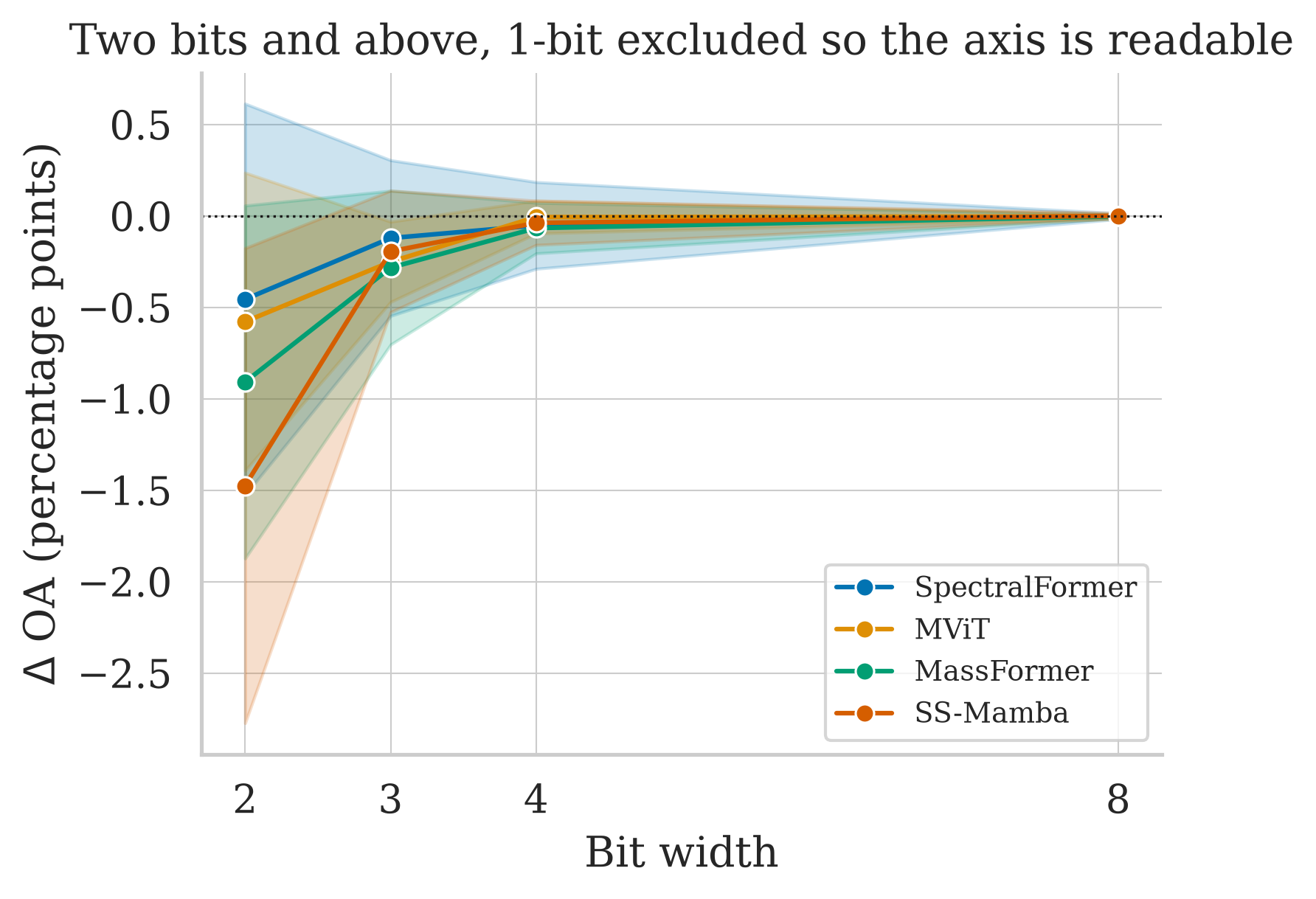
An Empirical Analysis of Weights Post-Training Quantization for Hyperspectral Image Classification. CVGIP 26 (Merit Paper Award) First systematic post-training quantization benchmark for Transformer- and Mamba-based hyperspectral image classifiers. Quantization is effectively lossless at higher bit widths. |
|
FPGA-Based Acceleration of Vision Transformers with Quantization and Token Reduction. VLSI/CAD 26 |
|
|
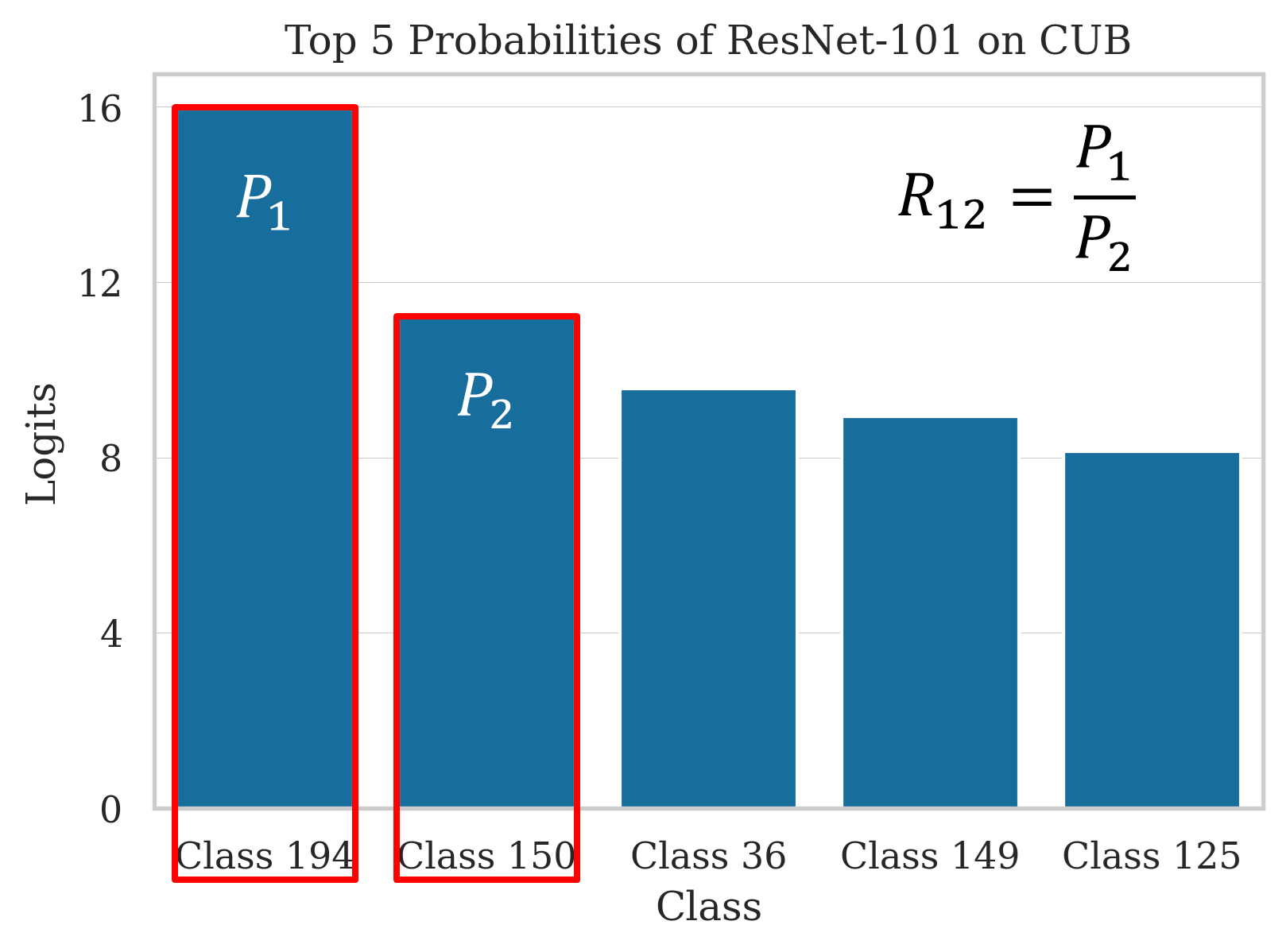
How to Choose Your Teacher for Fine Grained Image Recognition. CVPR FGVC Workshop 26 On the Role of the Teacher in Knowledge Distillation for Fine Grained Image Recognition. CVGIP 25 Systematic study of teacher selection for knowledge distillation on fine-grained datasets, where the usual rule of picking the most accurate teacher breaks down. Experiments across teacher-student pairs, datasets and distillation losses show which teacher properties predict student accuracy. [Paper] [Code] |
|
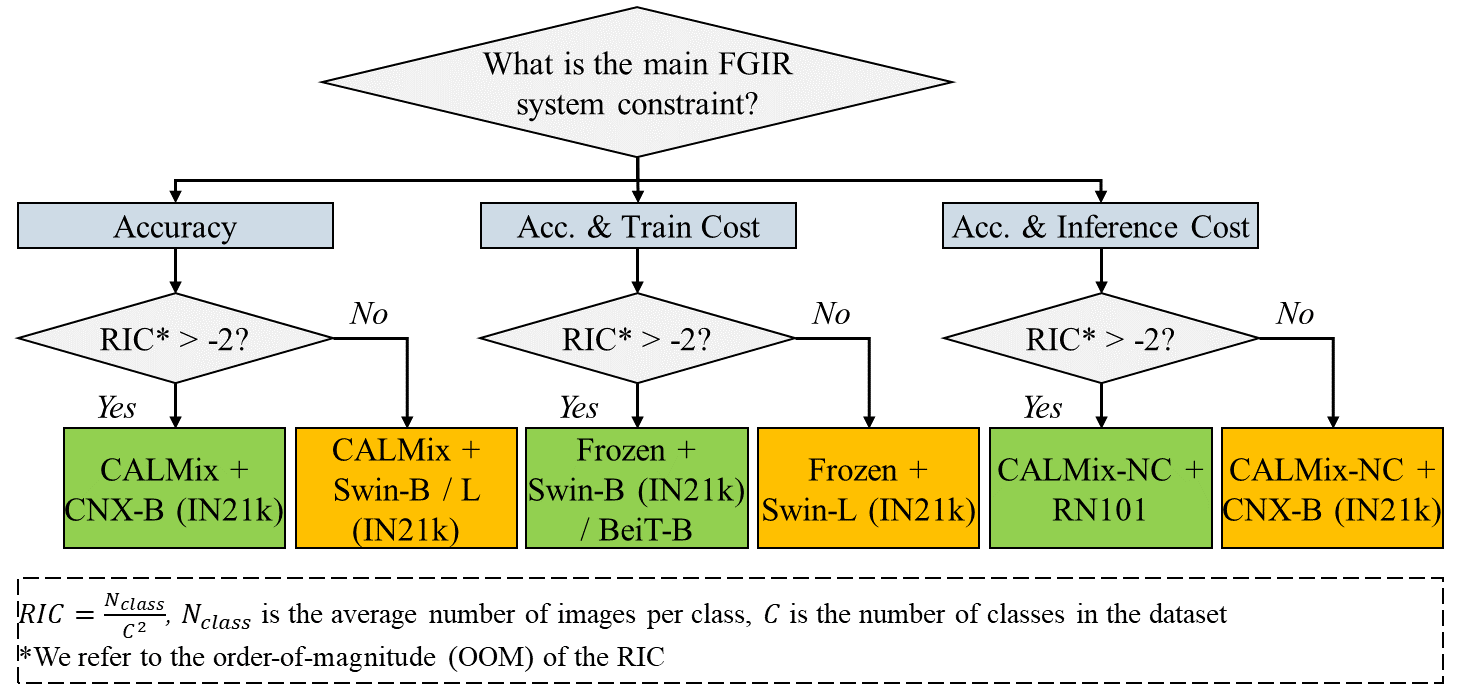
A Large-Scale Study on the Accuracy vs Cost Trade-offs of Training and Evaluation Settings in Fine-Grained Image Recognition. CVPR FGVC Workshop 26 Over 2,000 experiments across 16 backbones, 17 datasets and 6 training and evaluation settings to measure what FGIR-specific settings buy in accuracy and what they cost in training and inference time. Results distilled into a decision chart for choosing a backbone and setting under a given system constraint; 825 pretrained checkpoints released. [Paper] [Code] |
|
Switchable-Precision Universally Slimmable Networks. IEEE SPL 26 Revisiting the Backbone, Pretraining and Transferability for Hierarchical Fine-Grained Image Recognition. CVGIP 25 (Excellent Paper Award) A single network that runs at any width and at several weight precisions (SPL), and a study of how backbone and pretraining choices transfer to hierarchical fine-grained recognition (CVGIP, equal contribution). [Paper] |
|
|
UniTrac: A Unified FPGA Accelerator for GNN-based Particle Trajectory Reconstruction in High Energy Physics. ACM TRETS 26 |
|

|
Global-Local Similarity for Efficient Fine-Grained Image Recognition with Vision Transformers. ISCAS 25 Similarity between global and local representations as the criterion for discriminative region selection in FGIR. Thorough experiments across 10 FGIR datasets covering a variety of settings including image size and AugReg combinations. Our proposed model obtains the best accuracy on 8 of 10 datasets at much lower cost than the best on the others. [Paper] [Code] |
|
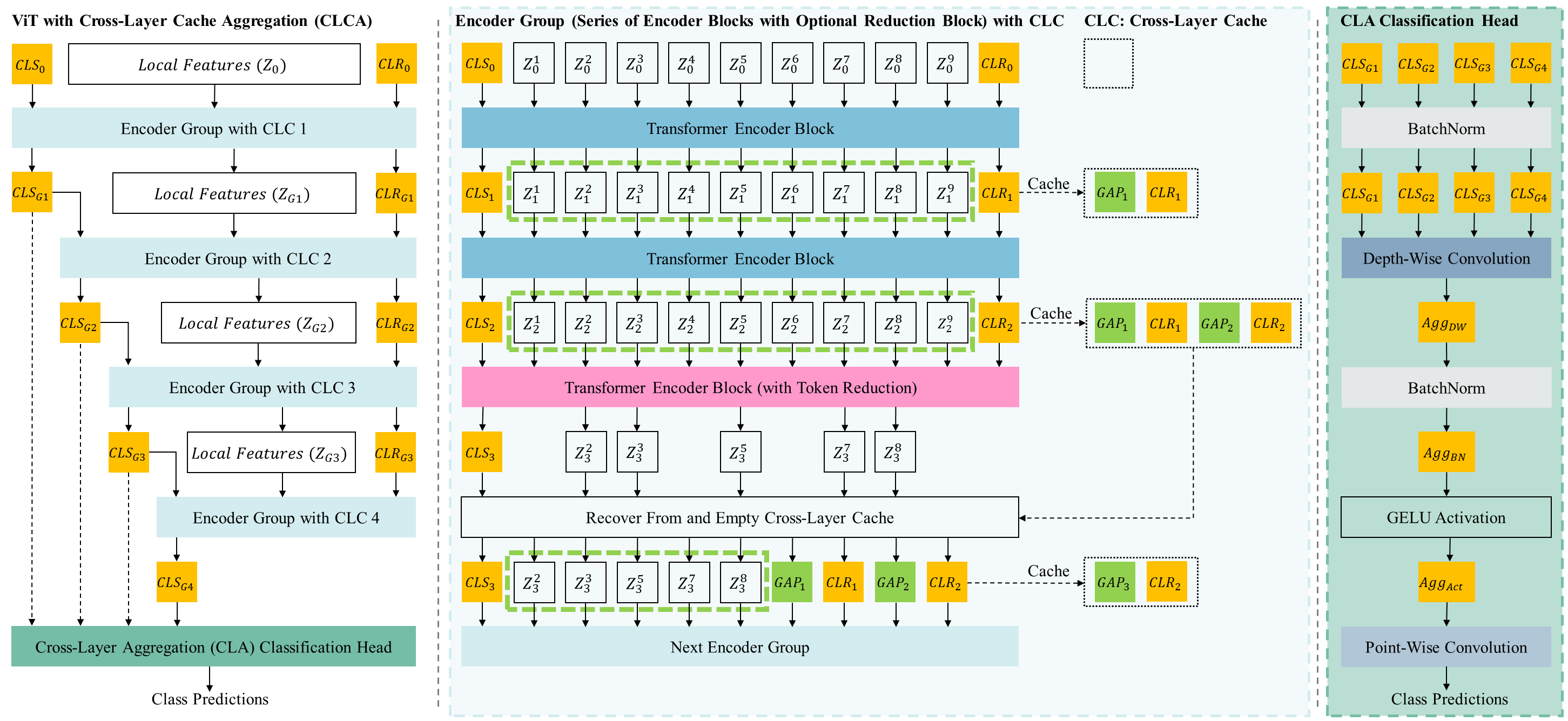
Cross-Layer Cache Aggregation for Token Reduction in Ultra-Fine-Grained Image Recognition. ICASSP 25 Plug-and-play modules to avoid information loss when applying token pruning methods for datasets with small inter-class differences. Thorough experiments across diverse datasets, backbones, token reduction methods, image sizes, and keep rates show our method enables significant cost savings while maintaining high accuracy. [Paper] [Code] |
|
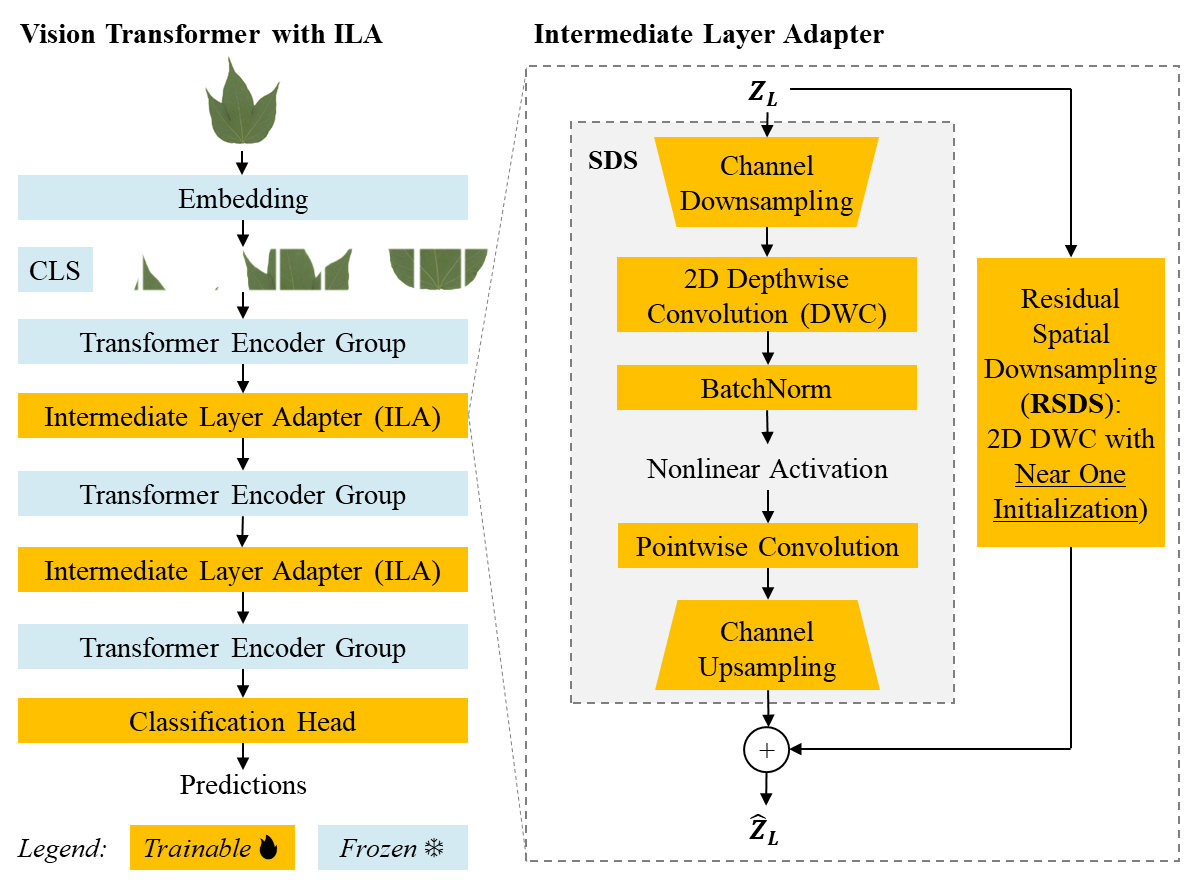
Down-Sampling Inter-Layer Adapter for Parameter and Computation Efficient Ultra-Fine-Grained Image Recognition. ECCV EFM Workshop 24 Addresses attention collapse under wide domain gap adaptation settings by proposing a down-sampling adapter module. At least 6.8% higher average accuracy than other parameter-efficient methods, with at least 123x fewer trainable parameters than state-of-the-art methods. [Paper] [Code] |
|
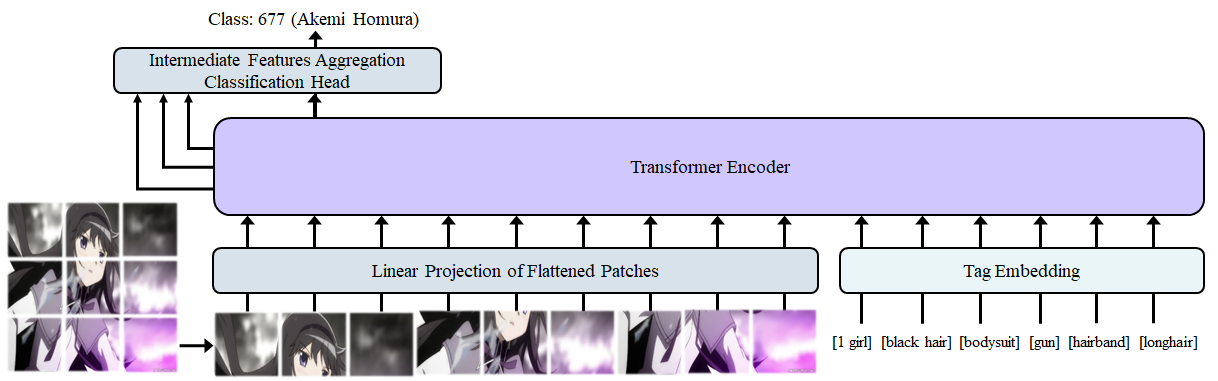
Anime Character Recognition using Intermediate Features Aggregation. ISCAS 22 Intermediate features aggregation classification head for reducing sensitivity to hyperparameters in ViTs at low computational cost. Experiments on how model architecture and hyperparameters affect classification performance. [Paper] [Code] |

|
DLPrPPG: Development and Design of Deep Learning Platform for Remote Photoplethysmography. ISCAS 22 Parametric Study of Performance of Remote Photopletysmography System. ISCAS 21 Systematic studies of remote photoplethysmography (RPPG) design hyperparameters (face detection method, region of interest selection scheme, sliding window size, preprocessing and postprocessing algorithm choice) and their effects on heart rate prediction accuracy in relation to computational cost using C++, Python and OpenCV. [Paper (ISCAS 22)] [Paper (ISCAS 21)] |
|
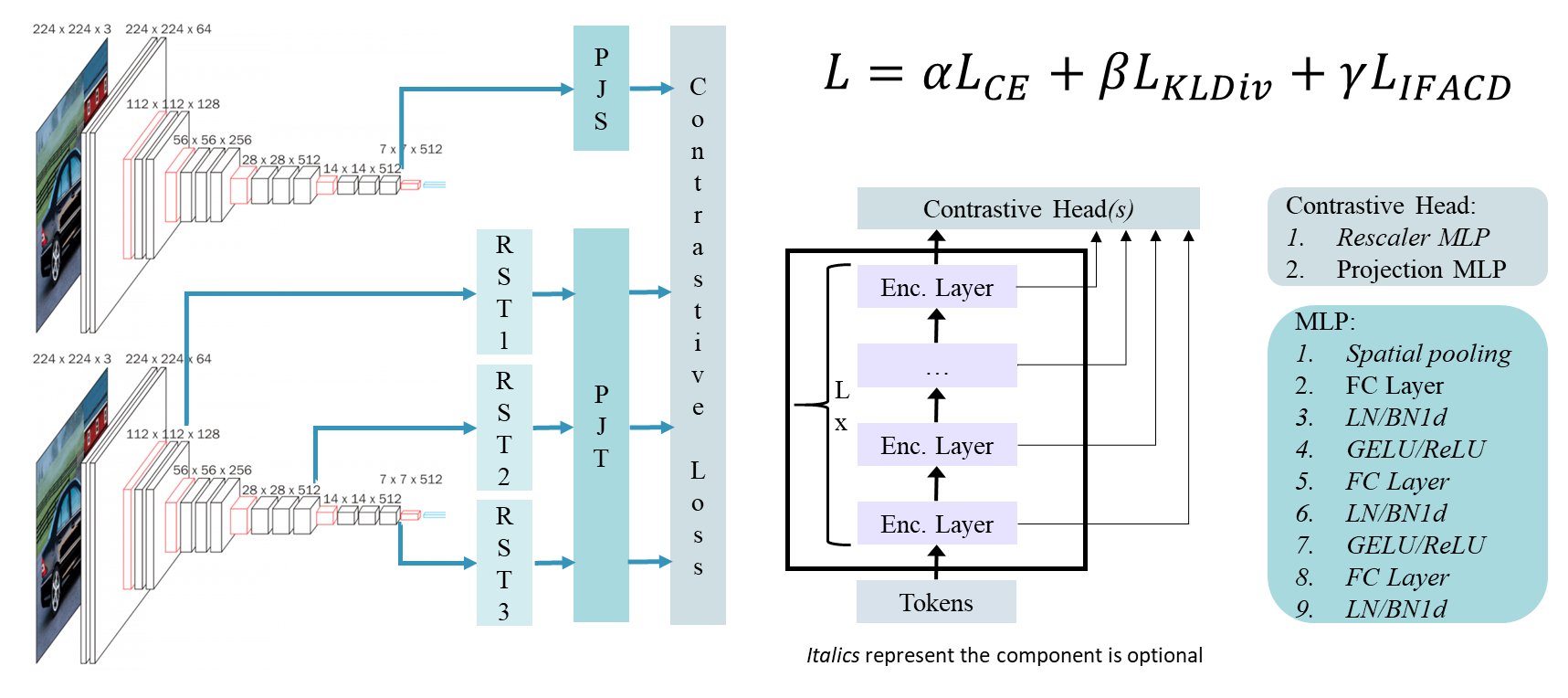
IFACD: Intermediate Features Augmented Contrastive Distillation. ICLR CSS Workshop 22 Extend contrastive learning framework (in particular SimCLR-like) to support features from intermediate layers of a particular image as additional positive pairs and intermediate features from other images in the batch as negative pairs, reducing reliance on augmentation pairs and large batch size requirements. Apply proposed contrastive loss in a knowledge distillation framework where intermediate features are extracted using a frozen teacher and the student learns using a combined contrastive, distillation, and supervised cross-entropy loss. Experiments with a variety of teacher-student combinations show our method obtains favorable accuracy at a competitive computational cost compared to alternatives. [Code] [Recorded Presentation (Starts at 2:47:50)] [Slides] |
|
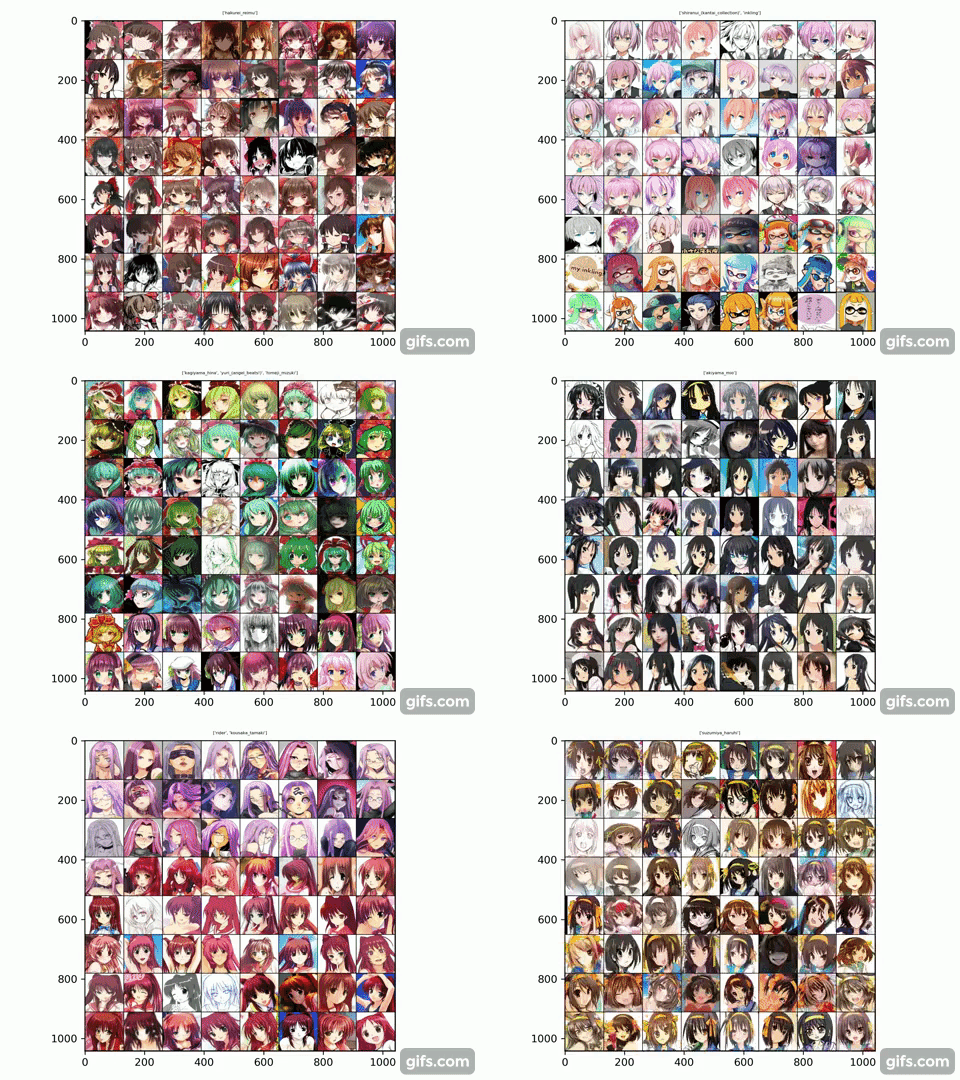
Vision Transformers for Anime Character Face Recognition Image classification of anime character faces using the state of the art for image recognition: vision transformers. Revamped a dataset for this task, DAF:re: almost 500K images and more than 3K classes. Conducted experiments on both CNN and self-attention based models, and explored for the first time the hyperparameter tuning (mini-batch and image size) of vision transformers for out-of-domain data. [Source code] [Paper on DAF:re] |

|
DeblurGAN for Deblurring of Videos Done in Python, using OpenCV and PyTorch. Final project for Digital Image Processing course (108-1). Also included slides for midterm presentation covering the DeblurGANv2 paper. [Final Project Poster] [DeblurGANv2 Paper Slides] |

|
Computer Vision for Autonomous Driving Done in Python, making use of TensorFlow, Keras, OpenCV, and ROS. Final project for Deep Learning course (108-1). Also included slides for midterm presentation covering the VGG network paper. [VGG Paper Slides] [Final Project Slides] |